REVIEW · KO PHI PHI DON
Ferry Transfer from Krabi Klong Jilad Pier to Phi Phi Tonsai
Book on Viator →Operated by Andaman Wave Master · Bookable on Viator
Ferry rides can make or break your day. This Krabi–Phi Phi transfer is built for comfort and speed, with a big ferry that runs on an open sea route in about 2 hours. I like the combo of easy check-in and a crossing that feels organized from start to finish, even when conditions aren’t perfect.
My main consideration is boarding. The ramps can be steep if you have mobility challenges, so plan for a careful step and give yourself extra time at the pier.
In This Review
- Key Points to Know Before You Go
- Krabi to Phi Phi in About 2 Hours: The Ride at a Glance
- Where You Board: Sai Thai Klong Jilad Pier to Tonsai
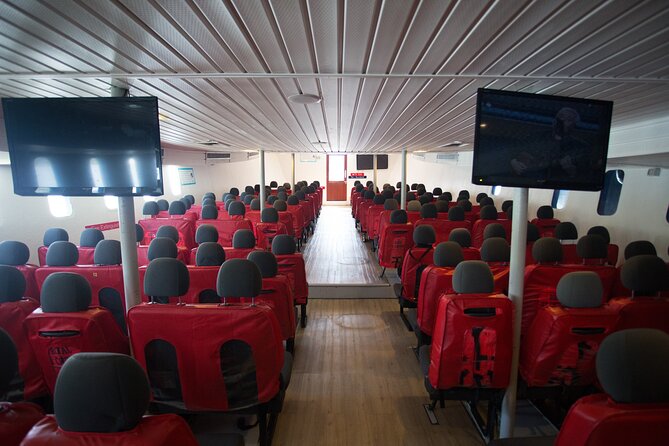
- The Royal Jet Cruiser Experience: Comfort, AC, and Restroom
- On-Time Plans vs. Real-World Delays
- Boarding Ramps, Seat Choice, and What to Bring
- The Extra Cost at Tonsai: Pier Entry Fee
- Price and Value: Is $14.12 a Good Deal?
- Who This Ferry Is Best For (and Who Should Think Twice)
- Booking Timing and What It Means for Your Day
- Should You Book This Krabi–Phi Phi Ferry?
- FAQ
- How long is the ferry ride from Krabi to Phi Phi Tonsai?
- Where does the ferry depart in Krabi?
- Where do you arrive on Phi Phi?
- What’s included in the ticket price?
- Is the Tonsai Pier entry fee included?
- How many travelers can be on this ferry transfer?
- Is there air conditioning on the boat?
- What happens if the weather is poor?
- What’s the cancellation window for a full refund?
Key Points to Know Before You Go
- Big ferry, big stability: Designed to handle up to 500 passengers, with this trip capped at 300 for smoother flow.
- Air-conditioned waiting and boat: Helps a lot in Krabi heat, even if cooling isn’t uniform across seating.
- Restroom onboard: A real comfort win on a 2-hour crossing.
- Smooth for many days, not immune to delays: Technical issues can push departure times back.
- Tonsai Pier fee is extra: Plan for 20 THB on arrival.
- Crew helps with luggage: You’ll usually get help loading and unloading your bags.
Krabi to Phi Phi in About 2 Hours: The Ride at a Glance
This is a straightforward ferry hop from Krabi to Phi Phi—no sightseeing stops, no long detours. The whole trip is listed at around 2 hours, which is exactly what you want when you’re trying to build a day on Phi Phi without burning half of it in transit.
The ferry itself is the star here. It’s a large boat that’s built to safely move a lot of people. In practical terms, that usually means a steadier ride than tiny speedboats and more room to spread out when the cabin gets busy. If you’re traveling with family or a group, that size matters.
You should also know there’s a restroom onboard. That sounds basic, but on warm-water crossings it’s one of those details you appreciate more than you expect.
Where You Board: Sai Thai Klong Jilad Pier to Tonsai
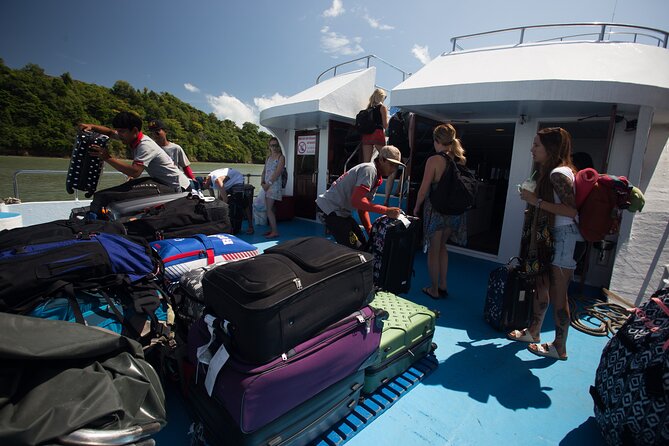
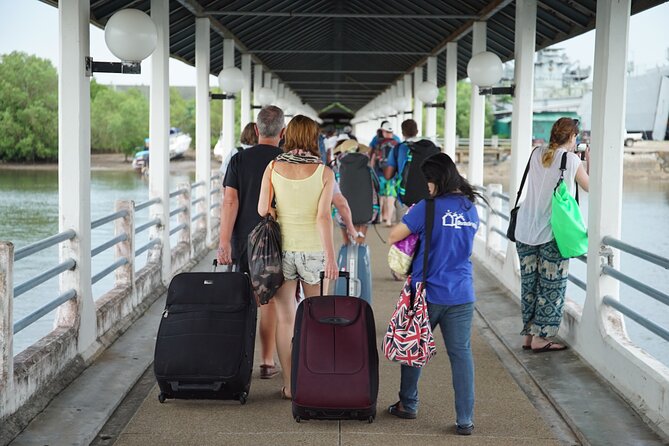
Your start point is Sai Thai Klong Jilad Pier in Mueang Krabi District, Krabi 81000. The ticket redemption point is also there, which keeps things simple: you go to one place, check in, and then board as the boat leaves on the departure time.
On Phi Phi, you arrive at Tonsai Pier. The listing also references Pier Hotel54, but what matters for your planning is that you’ll land at Tonsai—the main access point most people use to get around the island.
One small practical detail: there’s a meeting point where staff meet passengers before check-in. So don’t treat it like a “show up whenever” situation. Get there early enough to find the line, get your ticket sorted, and settle in before boarding ramps start moving.
The Royal Jet Cruiser Experience: Comfort, AC, and Restroom
This crossing runs on the Royal Jet Cruiser fleet, operated by Andaman Wave Master. The big selling point is comfort. The boat can take a lot of people (up to 500 capacity), and that size helps create a more stable experience on the water.
Here’s what you can realistically expect on comfort:
- A restroom onboard, which you’ll be glad to have for any unexpected waits.
- Air-conditioning. People report the waiting area is air-conditioned, and the boat has air-conditioning too. One note to keep in mind: cooling may feel uneven depending on where you sit. The middle of the cabin may be cooler than other areas, so pick your seat if you can.
- Plenty of space to move and stow bags. Bags are typically stacked for travel, and the crew assists with getting you on and off with luggage.
You also get onboard convenience like snacks. Some people mention a small shop on board with snacks at prices they considered fair. It’s not essential, but it’s useful when you board hungry.
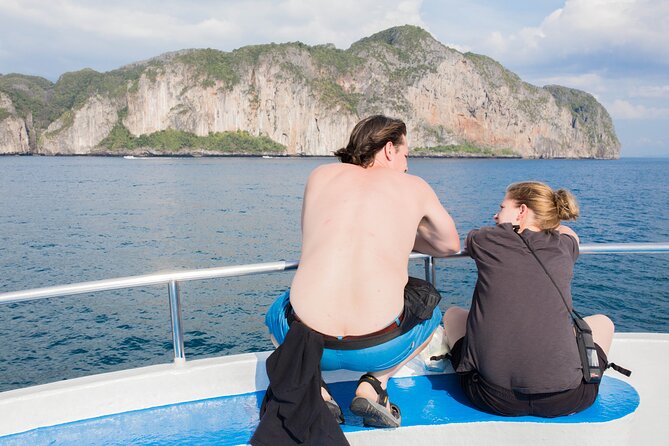
Views can be part of the fun. People mention good scenery from the ferry, and if the sea looks calm, it’s a nice “start of the trip” moment. If it looks rough, the larger boat generally helps you feel more comfortable than you would on a tiny craft.
On-Time Plans vs. Real-World Delays

This is advertised as a reliable ferry option, and many people describe the ride as smooth. You may even get good timing—some crossings are reported as punctual and well organized.
Still, it’s the ocean. One important reality from feedback: the service can run late due to technical reasons. In one case, a delay stretched well beyond an hour. Another issue mentioned is that departures and arrivals can take longer when extra passenger pickups happen along the way.
So how should you plan? Treat Phi Phi day plans like a “buffer-friendly” day. If you have a tight schedule—like a specific boat tour later that depends on you being on time—give yourself cushion. The ferry is only one piece of your day, and the sea controls more than anyone on land would like.
The good news is that when everything is working, the crossing is described as smooth, quick, and organized. It’s just not the type of ride where you should assume time will always behave.
Boarding Ramps, Seat Choice, and What to Bring
Boarding is where comfort can turn into a small challenge. One clear caution: the boarding ramps can be steep. If you have mobility issues, go slowly, hold what you need to hold, and consider leaving yourself extra minutes so you’re not rushing at the last second.
For seat choice, here’s the practical angle:
- If you tend to get hot, aim for the portion of the cabin that feels cooler. People report AC can be stronger in the middle.
- Windows can be high, which may limit your view from some spots on lower levels. If you care about scenery, you may prefer an upper deck area—just know sun protection might still matter depending on where you sit.
What to bring is simple:
- A light layer for air-conditioned areas (AC can feel strong once you’re inside).
- Sunscreen if you’re sensitive to sun, especially if you’ll spend time on open or upper areas.
- A small bag for water and snacks in case you want something beyond what the onboard shop offers.
Also, expect your bags to be handled and stacked. If you have valuables, keep them on your person rather than in checked bags. It’s not because the service is careless—just because that’s how you stay in control.
The Extra Cost at Tonsai: Pier Entry Fee
The ferry ticket includes the ferry transfer from Krabi to Phi Phi Tonsai, but it does not include the Tonsai Pier entry fee.
That fee is listed as 20 THB. It’s payable at the pier, so don’t plan to arrive with exactly zero cash. Even if you’re using a card often in Thailand, having small cash ready saves you time and frustration.
This is a small cost, but it’s one of those easy-to-miss items that can throw off your budget if you’re traveling on a tight daily plan.
Price and Value: Is $14.12 a Good Deal?
At $14.12 per person, the price is positioned as a solid value for a route that takes about 2 hours and brings you directly to Tonsai. You’re paying for:
- A large ferry service with basic onboard comforts (including a restroom)
- A transfer that avoids the hassle of piecing together separate legs of transportation
- The convenience of a set departure and a defined boarding location
Is it the cheapest option? Maybe, maybe not. But value isn’t only the lowest number—it’s also how predictable the experience feels and how much you’re paying to reduce stress.
This transfer includes the ticket itself, and you also get some practical extras like crew assistance with luggage and the comfort of air-conditioned spaces. If you’re carrying beach gear or traveling with people who don’t want a complicated transit day, that “less hassle” value adds up.
One detail to watch: some costs don’t show up until you reach Phi Phi—like the Tonsai Pier entry fee. So your real total is the ferry ticket plus that fee. Still, even with the add-on, it stays in a reasonable range for getting from Krabi to the main Phi Phi landing area.
Who This Ferry Is Best For (and Who Should Think Twice)
This transfer makes the most sense if you want:
- A direct Krabi-to-Phi Phi connection without side stops
- A larger ferry experience instead of a tiny craft
- A quick crossing that lets you get onto the island sooner
It can work for most people, since it’s designed for broad participation and has onboard basics. And if you’re traveling with family or friends who all have different comfort levels, a bigger vessel usually makes everyone feel less “on edge.”
Who should think twice?
- If you have mobility challenges, the steep boarding ramps are the biggest issue to consider.
- If you have a super tight schedule where being late by even an hour would ruin your day, add buffer time. The boat can experience delays due to technical issues.
If you’re the type who likes to keep the plan simple—show up, check in, ride, and arrive—this fits that style really well.
Booking Timing and What It Means for Your Day
This kind of transfer is booked on average 41 days in advance, which tells you something useful: better options tend to go earlier in the season or around busy periods.
If you’re traveling during peak dates, booking ahead helps you lock in a departure that matches your Phi Phi plans. If you wait too long, you may still find options, but you might lose flexibility on timing.
Also remember: the experience requires good weather. If conditions aren’t good, you may be offered another date or a full refund. That’s common for sea travel, but it’s still good to plan with a bit of adaptability—especially if you’re mapping out more than one activity on Phi Phi.
Should You Book This Krabi–Phi Phi Ferry?
If you want an easy, direct way to reach Phi Phi Tonsai from Sai Thai Klong Jilad Pier, this is a strong choice. The value is good, the ferry setup is comfortable for a lot of people, and you get real practical perks like a restroom onboard and air-conditioned spaces.
I’d book it if:
- You want a simple transfer that takes about 2 hours
- You like the comfort of a larger ferry
- You’re fine paying a small extra 20 THB fee on arrival at Tonsai
- You can build in a little time cushion in case the sea or the engine needs a moment
I’d hesitate if:
- You need guaranteed timing down to the minute
- Your mobility situation makes steep ramps a deal-breaker
Overall, it’s a sensible, well-paced ferry option for getting from Krabi to Phi Phi without turning travel day into a stress test.
FAQ
How long is the ferry ride from Krabi to Phi Phi Tonsai?
The crossing time is listed as about 2 hours (approx.).
Where does the ferry depart in Krabi?
It departs from Sai Thai Klong Jilad Pier in Mueang Krabi District, Krabi.
Where do you arrive on Phi Phi?
You arrive at Tonsai Pier on Phi Phi (the listing also references Pier Hotel54).
What’s included in the ticket price?
The included items are the ferry ticket from Krabi to Phi Phi Tonsai, plus a restroom onboard.
Is the Tonsai Pier entry fee included?
No. The Tonsai Pier entry fee is listed at 20 THB and is not included.
How many travelers can be on this ferry transfer?
This activity has a maximum of 300 travelers.
Is there air conditioning on the boat?
Yes. People report air-conditioned waiting areas and that the boat is air-conditioned, though cooling may feel uneven depending on where you sit.
What happens if the weather is poor?
This experience requires good weather. If it’s canceled due to poor weather, you’ll be offered a different date or a full refund.
What’s the cancellation window for a full refund?
Free cancellation is available up to 24 hours in advance for a full refund.